Retained Primitive Reflexes: How They Impact Learning, Behavior, and Regulation
By Radie Hain, OTD, OTR/L
If your child struggles with attention, coordination, or behavior—even though you’re doing “all the right things”—there may be a hidden root cause: retained primitive reflexes.
As pediatric occupational therapy practitioners, we frequently assess for retained reflexes because they play a crucial role in your child’s brain-body development. When these reflexes don’t integrate properly, they can create real roadblocks in learning, behavior, and everyday function.
Let’s break down what that means and why it matters.
What Are Primitive Reflexes?
Primitive reflexes are involuntary movement patterns that babies are born with. These reflexes help newborns during the birthing process, survive, and provide the foundation for motor development, posture, and coordination.
As children grow, their brains mature and fade away—or integrate—within the first year of life as the brain matures. This allows higher-level skills like motor coordination, learning, attention, posture, focus, and emotional regulation to develop. When they don’t, they’re considered retained and may interfere with those higher-level brain functions.
Some common ones include:
- Moro Reflex – the startle response
- ATNR (Asymmetrical Tonic Neck Reflex) – arm and leg movement when the head turns
- STNR (Symmetrical Tonic Neck Reflex) – supports crawling patterns
- TLR (Tonic Labyrinthine Reflex) – relates to posture and head position
- Landau– develops head, trunk, and leg extension for posture against gravity
- Spinal Galant – trunk movement in response to touch
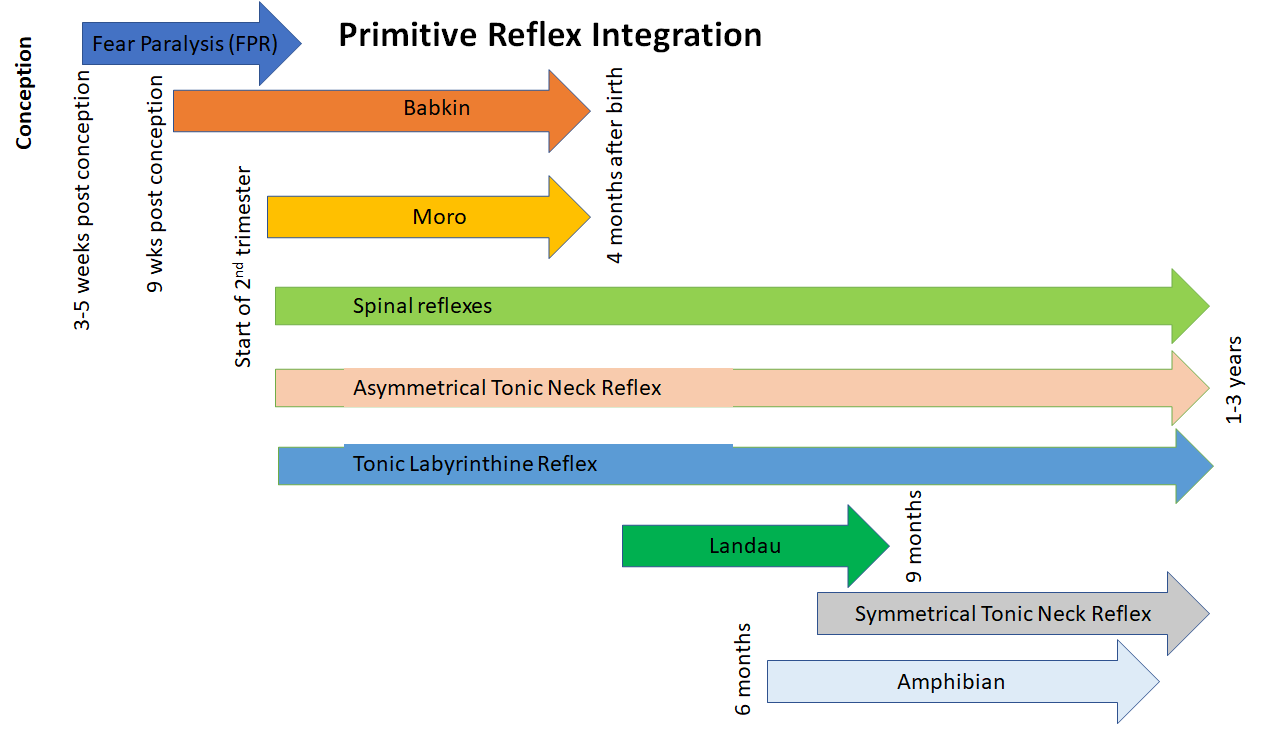
These reflexes are helpful early on, but they should integrate during approximately the first year of life as children gain control over their movements.
The Big Picture: How Retained Reflexes Affect Children
When reflexes remain active past infancy, the body continues to react automatically instead of intentionally. This means the nervous system has to work harder to stay organized. A child with retained reflexes may:
- Appear clumsy or uncoordinated
- Struggle with handwriting or reading
- Constantly fidget or have poor posture
- React emotionally or be sensitive to noise, tags, or touch
- Avoid sports, movement activities, or motor planning tasks
- Seem easily distracted or overly impulsive
- Experience meltdowns or difficulty self-regulating
It’s not that the child is choosing these challenges — their body is reacting before the brain has time to organize movement and behavior. They could be neurological signs that the body hasn’t finished building foundational connections.
Key Primitive Reflexes and Their Impact
Here’s a breakdown of the main primitive reflexes that we as occupational therapist work on and how their retention may affect your child’s everyday life:
✋ Moro Reflex (Startle Reflex)
- Triggered by sudden movement or loud noise.
- Retained signs: anxiety, poor stress tolerance, emotional outbursts, hypersensitivity to sensory input, trouble with transitions or change.
🏹 Asymmetrical Tonic Neck Reflex (ATNR)
- Head turn causes arm extension on one side and flexion on the other.
- Retained signs: difficulty crossing midline, poor handwriting, tracking issues during reading, posture challenges.
🤸♀️ Symmetrical Tonic Neck Reflex (STNR)
- Neck movement influences arm and leg movement.
- Retained signs: poor posture, trouble sitting still, slouched position, awkward crawling phase, difficulty copying from the board.
🕷 Spinal Galant Reflex
- Stimulated by touch along the spine.
- Retained signs: constant squirming, poor focus, bedwetting, sensitivity to tight clothes or tags.
🦶 Tonic Labyrinthine Reflex (TLR)
- Movement of head forward/backward affects body tone.
- Retained signs: poor balance, difficulty climbing stairs, fear of heights, spatial awareness issues, low or high muscle tone.
🌀 Landau Reflex (postural)
- Supports motor development like crawling and posture.
- Retained signs: weak postural control, poor motor planning, coordination challenges, delayed gross motor milestones.
✋ Fear Paralysis Reflex (FPR)
- Triggered by perceived threat, unfamiliar situations, or emotional stress.
- Retained signs: withdrawal or freezing, extreme shyness, avoidance of new tasks, low confidence, heightened anxiety, difficulty initiating movement or speech, over-reliance on others, and challenges with social engagement.
🔄 Rooting Reflex
- Helps newborns find the nipple for feeding.
- Retained signs: speech delays, poor articulation, drooling, hypersensitive mouth area, difficulty with eating textures or brushing teeth.
🍼 Sucking and Swallowing Reflex
- Supports feeding in infancy.
- Retained signs: poor tongue coordination, difficulty with chewing/swallowing, speech delays, and mouth fixation.
🤲 Palmar Grasp Reflex
- Reflexive grasp when something touches the palm.
- Retained signs: poor fine motor control, immature pencil grip, fatigue with handwriting, trouble releasing objects.
🧍♂️ Plantar Grasp Reflex
- Toes curl when the sole is touched.
- Retained signs: balance and coordination difficulties, toe walking, trouble with standing flat-footed.
How Retained Reflexes Affect Learning
In the classroom, retained reflexes can interfere with important school skills, including:
- Crossing midline (moving one side of the body across the other)
- Visual tracking for reading
- Bilateral coordination (using both sides together)
- Sustaining posture at a desk
- Eye-hand coordination
For example, a retained ATNR may cause the arm to move when the head turns, which can disrupt handwriting, copying from the board, and desk work.
Children may appear distracted, clumsy, or fatigued even when they’re trying their best.
How Retained Reflexes Affect Behavior & Regulation
Because reflexes are tied to the nervous system, they also influence emotional and behavioral regulation. Kids with retained reflexes may:
- Startle easily
- Have difficulty calming their bodies
- Seek constant movement
- Avoid certain positions or activities
- Feel overwhelmed in busy environments
- Show big emotional reactions
Again, this isn’t intentional behavior — it’s the nervous system staying in a reactive state instead of a calm, organized one.
How OT Can Help with Retained Reflexes
As pediatric occupational therapist we look at the whole child — movement, posture, sensory processing, attention, and daily skills. This is done through the occupational therapy process:
- Evaluate for retained reflexes using movement and sensory-based assessments.
- Create customized programs using rhythmic movement, balance activities, and sensory input to support integration.
- Work through play-based functional activities, which naturally engages the brain and body to promote neurodevelopmental progress.
Reflex integration is a gentle, non-invasive way to help children improve:
- Attention span
- Balance and core strengthening
- Bilateral coordination tasks
- Confidence in daily tasks
- Controlled movement patterns
- Emotional control
- Functional skill practice for school and home
- Motor skills
- Self-regulation
- Sensory integration strategies
The goal isn’t just exercises — it’s helping the nervous system become more organized so learning and behavior come more naturally.
Why Movement Matters
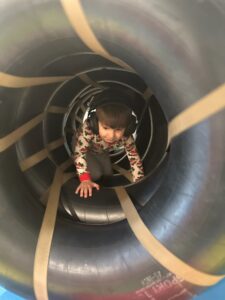
Movement is how the brain organizes itself. When kids move, climb, balance, push, pull, and play, they strengthen the connections between the body and brain.
This helps:
- Improve posture and stability
- Build coordination
- Support attention and focus
- Regulate emotions
- Develop confidence
Play-based movement gives the nervous system the input it needs to mature and integrate these early patterns– primitive reflexes.
When Should Parents Seek Support?
You might consider an OT evaluation if your child:
- Struggles with attention or sitting still
- Has messy or tiring handwriting
- Appears clumsy or uncoordinated
- Gets overwhelmed easily
- Avoids movement or constantly seeks it
- Has difficulty with posture or endurance
Early support builds strong foundations for learning, confidence, and independence.
Could Retained Reflexes Be Affecting Your Child?
Retained reflexes are often hidden, but their impact on learning and behavior can be big. When the body is organized, the brain can focus, regulate, and grow.
If you’re wondering whether movement or sensory challenges are affecting your child, and they are struggling with behavior, learning, or attention—and traditional strategies haven’t helped—retained reflexes might be the missing piece of the puzzle. Occupational therapy can help uncover what’s underneath and build the skills they need to thrive. We’re here to support your child’s development from the ground up—literally!
📍 If your child is struggling pediatric OTs can help your child build skills for participation in everyday life. Contact us at 785-594-2909.